
Field service transformation is often positioned as a game-changer—improving efficiency, reducing costs, and enhancing customer satisfaction. Yet, a significant number of field service implementations fail to deliver expected ROI. Whether you’re deploying Salesforce Field Service or any other FSM platform, the pattern of failure is surprisingly consistent.
This blog breaks down the real reasons behind failed implementations and provides a practical, execution-focused framework to help you avoid them.
The Reality: Why Field Service Projects Struggle
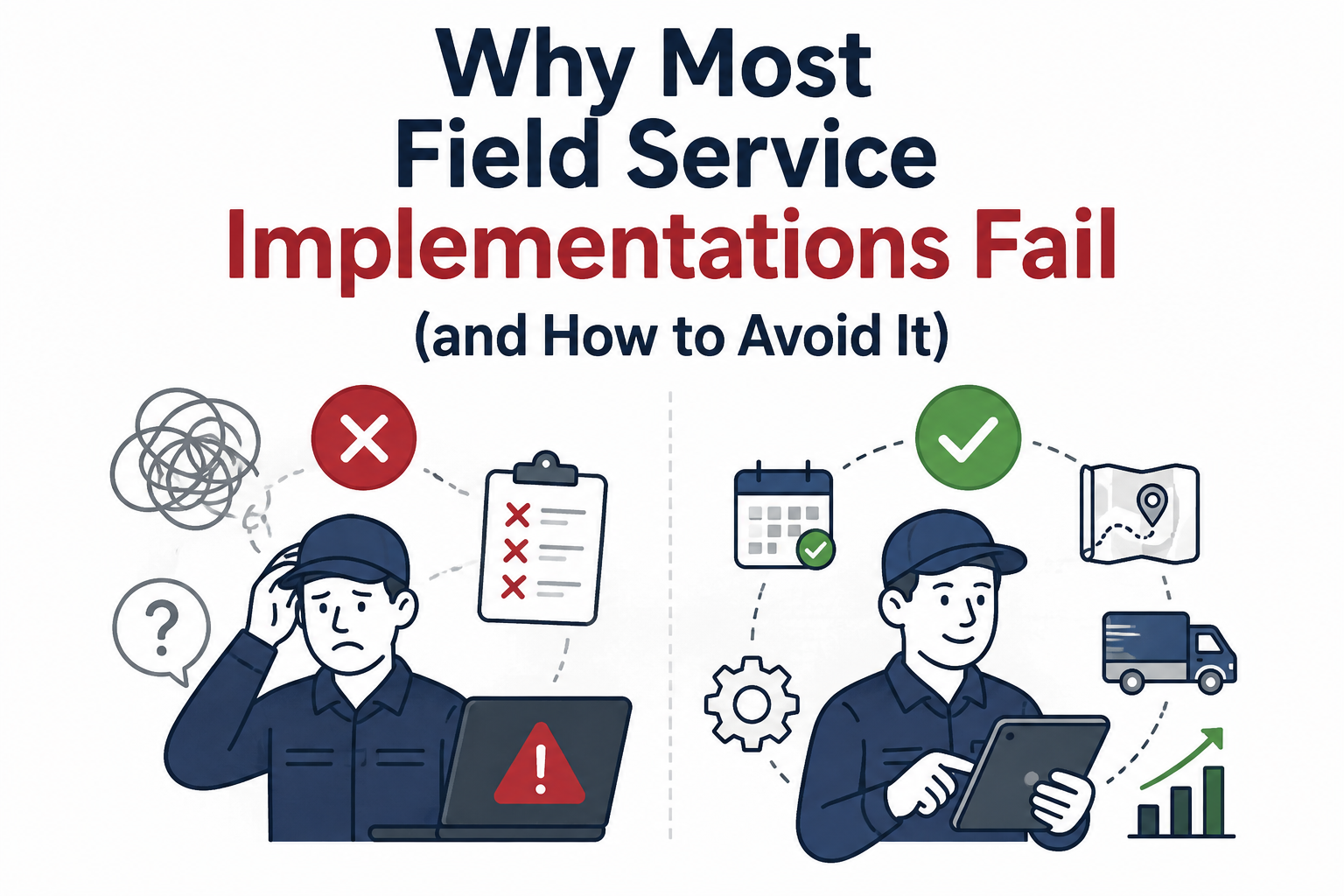
Despite strong technology platforms, failure is rarely about the tool—it’s about strategy, execution, and adoption gaps.
1. Lack of Clear Business Objectives
Most implementations begin with vague goals like:
- “Improve efficiency”
- “Digitize field operations”
Without measurable KPIs, the project lacks direction.
Common mistake:
Jumping into configuration without defining:
- First-Time Fix Rate (FTFR)
- Mean Time to Repair (MTTR)
- Technician utilization
How to avoid it:
Define success metrics upfront and align them with business outcomes:
- Cost reduction targets
- SLA compliance
- Customer satisfaction (CSAT)
2. Over-Engineering the Solution
Organizations often try to replicate every legacy process—resulting in:
- Complex workflows
- Heavy customization
- Difficult maintenance
This is especially common in platforms like Salesforce where flexibility can become a double-edged sword.
Common mistake:
“Let’s automate everything from Day 1.”
How to avoid it:
Adopt a phased implementation approach:
- Phase 1: Core scheduling and dispatch
- Phase 2: Optimization and automation
- Phase 3: AI-driven enhancements
3. Ignoring Field Technician Experience
Executives design processes—but technicians use them.
If the mobile experience is:
- Slow
- Complicated
- Data-heavy
Adoption will fail.
Common mistake:
Designing workflows without technician input.
How to avoid it:
- Conduct ride-alongs
- Build mobile-first experiences
- Minimize clicks and manual entry
4. Poor Data Quality and Migration Strategy
Field service runs on accurate data:
- Asset history
- Location data
- Service records
Bad data leads to:
- Incorrect scheduling
- Inefficient routing
- Poor customer experience
Common mistake:
Underestimating data cleansing effort.
How to avoid it:
- Perform data profiling and cleansing
- Define data governance policies
- Validate migration with pilot datasets
5. Weak Change Management
Even the best system fails without adoption.
Resistance typically comes from:
- Technicians
- Dispatchers
- Middle management
Common mistake:
Treating implementation as a “technical project” instead of a business transformation.
How to avoid it:
- Stakeholder alignment workshops
- Role-based training programs
- Incentivize adoption with performance metrics
6. Unrealistic Timelines and Budget Pressure
Leadership often expects:
- Faster delivery
- Lower cost
- Immediate ROI
This leads to:
- Compromised design
- Incomplete testing
- Poor rollout
How to avoid it:
- Set realistic milestones
- Include buffer for:
- UAT cycles
- Training
- Hypercare support
7. Lack of Post-Go-Live Optimization
Many organizations treat go-live as the finish line.
In reality, it’s just the beginning.
Common mistake:
No continuous improvement roadmap.
How to avoid it:
- Track KPIs continuously
- Establish a Center of Excellence (CoE)
- Plan quarterly optimization cycles
A Proven Framework for Successful Field Service Implementation
To avoid failure, follow this structured approach:
Phase 1: Strategy & Discovery
- Define KPIs and success metrics
- Map current vs. future state processes
- Identify quick wins
Phase 2: Design & Build
- Use standard features wherever possible
- Limit customization
- Focus on usability
Phase 3: Pilot & Validate
- Run controlled pilot programs
- Gather technician feedback
- Iterate quickly
Phase 4: Rollout & Train
- Role-based training
- Strong communication plan
- Executive sponsorship
Phase 5: Optimize & Scale
- Monitor performance dashboards
- Introduce AI and predictive capabilities
- Continuously refine processes
Key Takeaways
Field service implementation failures are predictable—and avoidable.
Success depends on:
- Clear business alignment
- Simplicity in design
- Strong adoption strategy
- Continuous optimization
Organizations that treat field service as a long-term transformation initiative, rather than a one-time IT project, consistently outperform their peers.
Final Thought
Technology like Salesforce Field Service can significantly enhance field operations—but only when implemented with the right strategy.
If you’re planning or struggling with a field service rollout, the real question isn’t:
“Is the platform capable?”
It’s:
“Are we implementing it the right way?”